Quick answer: You can do lymphatic drainage on yourself. The rules are the same everywhere on the body: very light pressure (stretch the skin, don't press the muscle), open the "drains" first (above the collarbones, then armpits and groin), and always stroke toward the nearest lymph nodes. A full-body session takes about 15 minutes; single zones take 3–5. Most people feel lighter right after and see less puffiness the same day; the effect is temporary, which is why it works best as a routine.
2-minute quiz → which zones, how many minutes, your daily plan
How lymph moves, in one paragraph
Lymph is fluid that leaks out of blood vessels into your tissues and has to find its way back. It travels through thin vessels just under the skin, passes through lymph nodes (clusters in the neck, armpits, belly and groin) and empties into the bloodstream near the collarbones. There's no pump. Muscle movement, deep breathing and gentle skin stretch move it. Self-massage is the skin-stretch part: light, rhythmic strokes in the direction the fluid already flows.
The four rules
- Skin-light pressure. If you can feel muscle under your fingers, it's too much. Think of moving the skin over the tissue, not pressing into it. No oil is required; if you use it, use very little.
- Open the drains before you push anything toward them. Order: collarbones → neck → armpits → belly → groin. Then work each zone toward its nodes.
- Direction: toward the nodes. Face and neck drain down to the collarbones. Arms drain to the armpits. Chest drains to the armpits. Belly drains up toward the chest and down toward the groin. Legs drain up to the groin, then the belly.
- Slow and repetitive. About one stroke per second, 5–10 repeats per area, with slow breathing. Speed and force do nothing except bruise you.
The 15-minute full-body sequence
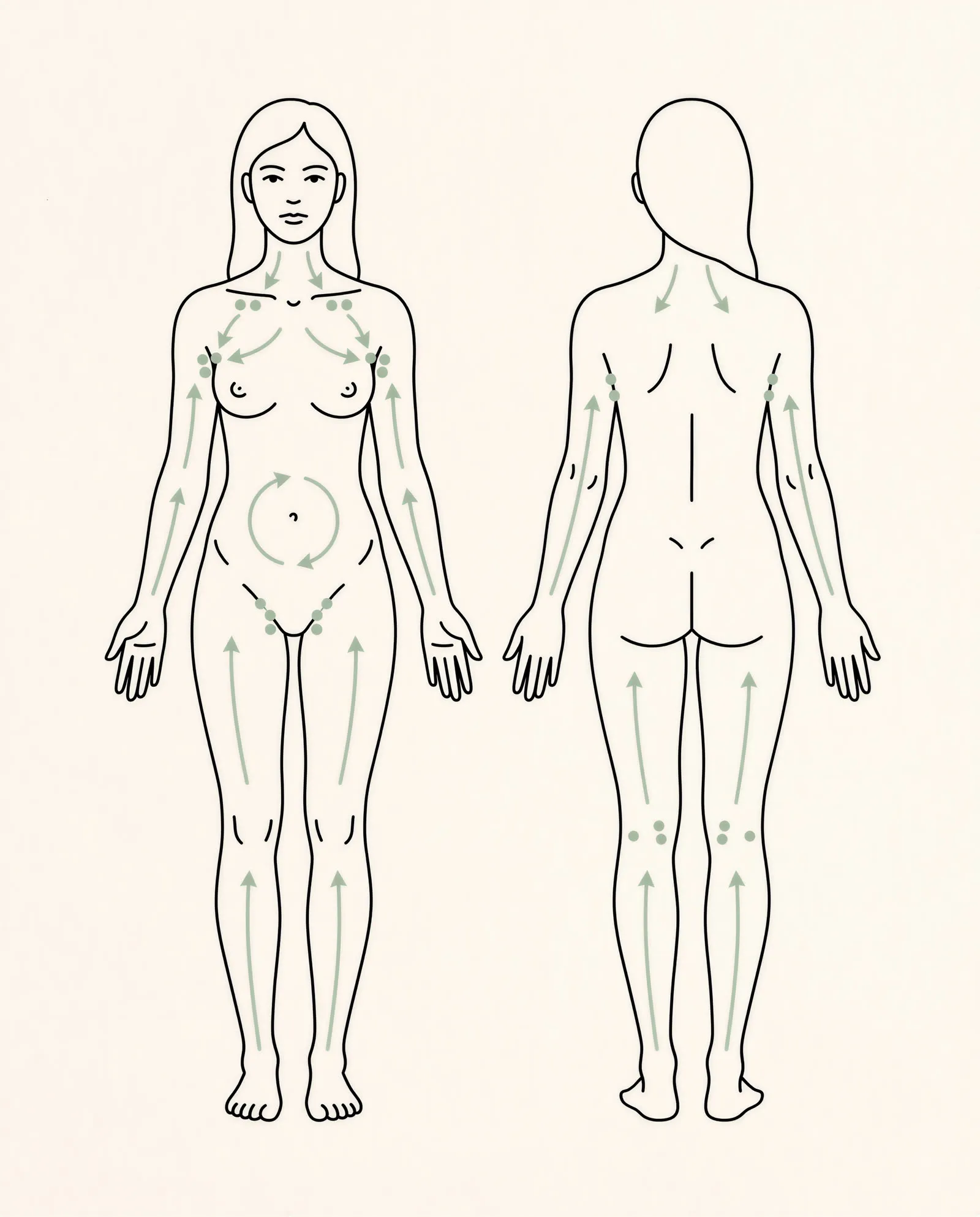
Download the direction chart (printable)
Step 1. Breathe (1 minute). Lying down or sitting tall, hands on the lower ribs. Five slow breaths into the belly. The diaphragm is the strongest lymph pump you have; this alone moves fluid from the lower body toward the chest.
Step 2. Collarbones (1 minute). Fingertips in the hollow above each collarbone. Gentle press-and-release pumps, 10–15 times. This is where all lymph exits into the blood; opening it first gives everything else somewhere to go.
Step 3. Neck (1 minute). Flat fingers under the ears, stroke down the sides of the neck to the collarbones, 5–10 times. Then from the back of the neck forward and down.
Step 4. Armpits (1 minute). Cup a hand under the opposite armpit. Gentle pumps, 10 times each side. Many nodes live here; opening them prepares the arms and chest.
Step 5. Arms (2 minutes). One arm at a time. Upper arm: stroke from the elbow toward the armpit, 5–10 times. Forearm: from the wrist toward the elbow. Hand: from fingers toward the wrist. Then a final sweep from the hand all the way to the armpit.
Step 6. Chest and upper back (1 minute). From the center of the chest outward toward each armpit, above the breast tissue, 5–10 times. Reach over the shoulder and stroke from the upper back toward the armpit.
Step 7. Belly (3 minutes). The most-requested zone; it has its own full guide at Lymphatic drainage for bloating. Short version: hands flat on the belly, five deep breaths; then slow clockwise circles around the navel with the whole palm; then strokes from the sides of the waist toward the navel, and from the lower belly down toward the groin creases.
Step 8. Groin (1 minute). Fingertips in the crease where the thigh meets the torso. Gentle pumps, 10 times each side. This is the drain for the legs.
Step 9. Legs (3 minutes). One leg at a time, ideally with the leg slightly raised. Thigh: stroke from the knee toward the groin, front, sides and back. Calf: from the ankle toward the back of the knee. Foot: from the toes toward the ankle. Finish with long strokes from the foot to the groin. Detailed version: Lymphatic drainage for legs.
Step 10. Finish (1 minute). Collarbone pumps again, five deep breaths, drink a glass of water.
Face gets its own routine, best done in the morning: Lymphatic drainage for the face.
Single-zone versions
- 3 minutes, face: collarbones → neck → face outward and down. Guide
- 5 minutes, bloating: breathe → collarbones → belly circles → sides to navel → down to groin. Guide
- 5 minutes, heavy legs: breathe → groin pumps → thigh → calf → foot → long sweeps, legs raised. Guide
- Prefer a tool? Dry brushing, rebounding or a vibration plate add pumping; hands are enough.
Not sure which you need? The quiz builds a plan from your zones and the time you actually have.
How often
Daily is fine and is what most people who like it end up doing. Two or three times a week still helps. There's no benefit to multiple sessions a day; lighter and more often beats hard and rare. Morning for puffiness, evening for heaviness after sitting.
What to expect, honestly
Right after: a lighter feeling, sometimes the urge to pee, a runny nose or a gurgling belly (fluid moving). Same day: less puffiness where you worked. Over weeks: no permanent change in your body; what changes is how often you wake up puffy, because you're clearing it daily. The strongest research on manual lymphatic drainage is for medical swelling (after surgery, lymphedema); for everyday puffiness the evidence is thinner, and we say so. See before and after and what the science supports.
Mistakes to avoid
- Pressing like a deep-tissue massage. Lymph vessels collapse under pressure.
- Starting at the puffy area instead of the drains.
- Pushing fluid the wrong way (up the neck, down the arm).
- Rushing. Slow strokes, slow breath.
- Expecting it to replace movement, sleep, water and less salt. It supports them.
Who should skip it or ask first
Skip if you have an active infection, fever, blood clot or suspected clot (sudden one-sided leg swelling, pain, warmth), or open skin. Ask a clinician first if you have heart, kidney or liver conditions that cause swelling, are pregnant, are being treated for cancer, or have lymphedema; in that case a certified lymphedema therapist should teach you the technique. If any stroke hurts, you're doing it wrong: correct drainage never hurts.
FAQ
Can I do lymphatic drainage massage myself?
Yes. Self-massage is standard practice, even in clinical settings; the technique is light strokes toward the lymph nodes in the right order.
What is the fastest way to drain your lymphatic system?
There's no "flush." The fastest everyday helpers are deep belly breathing, walking or rebounding, and light self-massage starting at the collarbones. Together they take 15 minutes.
What are the signs you need lymphatic drainage?
Morning face puffiness, a tight or bloated belly, heavy legs and swollen ankles by evening, rings tighter at night. These are normal fluid shifts, not a diagnosis; see signs your lymph is sluggish.
Is there a downside to lymphatic drainage?
Done lightly, rarely. Too much pressure can bruise or irritate skin. People with certain medical conditions should get guidance first (see above).
Do you poop or pee a lot after lymphatic drainage?
Extra bathroom trips are common; fluid is returning to the blood and your kidneys clear it. Bowel changes are usually from the belly strokes stimulating the gut.
What are the signs my lymphatic system is clogged?
"Clogged" isn't a medical state for most people; sluggish drainage shows as puffiness and heaviness that improves with movement. Persistent, one-sided or painful swelling is different and needs a clinician.
Should I use oil or a tool?
Optional. Bare clean hands work. A little oil helps tools glide; gua sha and rollers are fine with the same light pressure and direction.
Sources
- Cleveland Clinic. How to perform a lymphatic drainage self-massage (patient education).
- University Health Network (Toronto). How to do self lymphatic massage on your lower body / upper body.
- Ezzo J et al. Manual lymphatic drainage for lymphedema following breast cancer treatment. Cochrane Database Syst Rev. 2015.
- Moore JE, Bertram CD. Lymphatic system flows. Annu Rev Fluid Mech. 2018.
Lymph Plan team. Wellness information, not medical advice.